
START HERE
The short answer
Yes. Avocado oil can become rancid as it deteriorates. Protect it from heat, light and air, follow its storage instructions, and replace oil with a clearly stale or unpleasant odor rather than trying to disguise it in cooking.
- Use the label as a guide, not proof of present freshness.
- A stale smell is a reason to replace the oil.
- Smell and appearance cannot verify purity.
Separate freshness from purity
UC Davis research treats oxidation and adulteration as different quality questions. An oil can deteriorate during storage, while an adulterated product may contain an oil not represented by its label. A kitchen smell check cannot establish the full composition of a bottle.
This distinction helps you make a useful decision without overclaiming. You can decide that an unpleasant-smelling bottle is unsuitable for your meal. You cannot conclude that every bottle from a brand is pure, fresh or defective based on that one observation.
Sources: UC Davis: olive and avocado oil freshness research; UC Davis: avocado oil quality research
Notice a change from the oil's usual aroma
UC Davis describes fresh virgin avocado oil as having grassy, buttery characteristics, sometimes with a mushroom note. Refined oil may be much milder. A stale smell, including a play-dough-like impression, can indicate rancidity rather than the expected character of fresh oil.
Pour a little into a clean vessel if you need to inspect the oil away from a greasy bottle neck. Do not keep tasting an obviously suspect product to prove a point. Compare your observation with the product type and contact the maker if the bottle seems wrong immediately after opening.
Choose a cool, dark storage spot
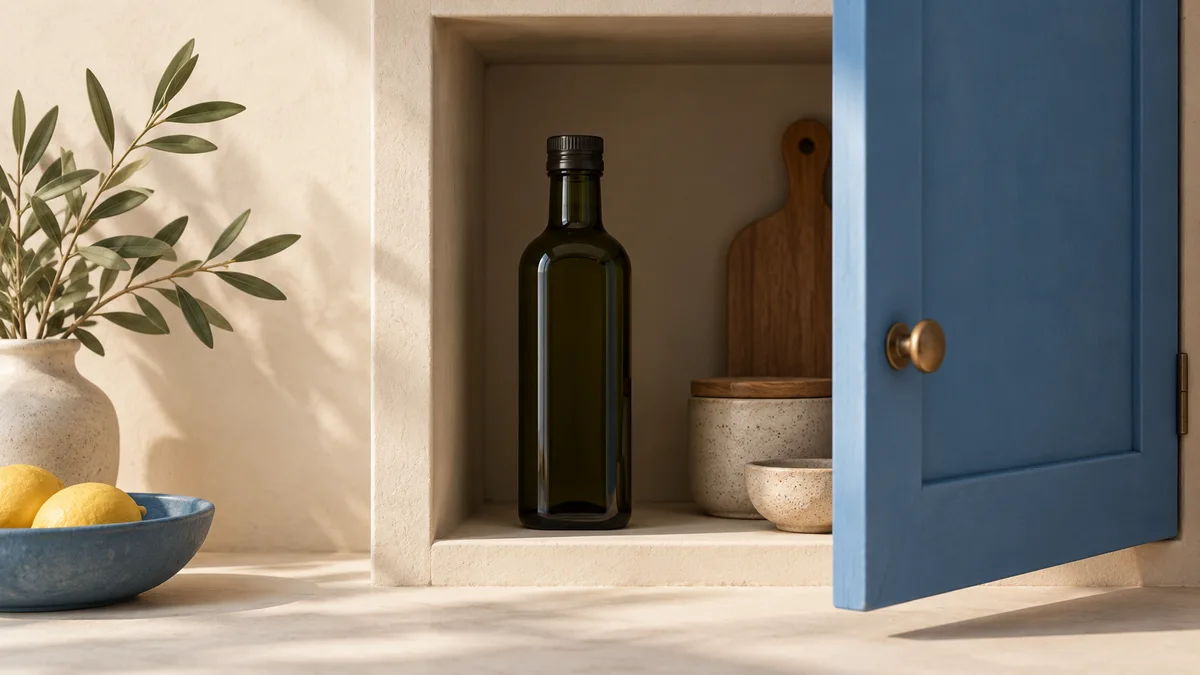
Heat, light and air work against freshness. A cupboard away from the cooking surface is a more sensible default than a sunny windowsill or a shelf directly above a hot range. Follow the bottle's directions when they specify a different storage condition.
Make the habit convenient: keep only the bottle you are using accessible, close it after pouring, and return it to its storage spot. If you decant it for the table, use a clean food-safe container and retain the original label and batch details.
Buy for your actual cooking pace
A larger bottle is only useful if you use its contents while they remain enjoyable. As an illustrative planning exercise, note how long your current bottle lasts before choosing the next size. That household record is more useful than assuming everyone finishes oil at the same rate.
Write the opening date on a removable label so an old bottle does not become an anonymous pantry resident. This is an organizational aid, not a newly invented expiration date. Use the maker's best-by and after-opening guidance, and do not promise yourself a fixed number of months from a generic article.
| Observation | Practical next step |
|---|---|
| New bottle smells clearly stale | Stop using it and contact the retailer or maker |
| Opened date is unknown | Review storage history and condition |
| Bottle sits near stove heat | Move it to suitable cool, dark storage |
| Bulk bottle lasts a very long time | Consider a smaller size next time |
Sources: UC Davis: olive and avocado oil freshness research; UC Davis: avocado oil quality research
Do not use cooking to conceal poor oil
A strongly flavored curry or high-temperature cooking does not make a deteriorated oil fresh again. If the smell is plainly unpleasant, replacing the oil is a more reliable choice than searching for a recipe that will hide it.
Record the product name, batch and purchase date before contacting the supplier about a problem. Keep the report specific to what you observed. A freshness complaint is useful evidence about that bottle; it is not a laboratory finding about every product sold under the same label.
Sources: UC Davis: olive and avocado oil freshness research; UC Davis: avocado oil quality research
Common questions
Can avocado oil go bad before its best-by date?
Yes. The date does not prove its current condition. Storage and initial quality matter, and UC Davis has investigated freshness problems in commercial oils.
Does green color prove avocado oil is fresh?
No. Color varies with processing and is not a reliable freshness or purity test.
Is there one shelf life for every opened bottle?
No. Follow the specific product guidance and consider storage conditions rather than treating a universal month count as a guarantee.
Sources and editorial approach
ChooseRight researched the sources below to explain the topic and its practical trade-offs. Examples are illustrations, not results from our own product testing. Sources checked October 30, 2026. Artwork is AI-generated for explanation and does not document hands-on testing.