
START HERE
The short answer
Find the exact model's estimated annual kWh on its EnergyGuide label and multiply it by your electricity rate per kWh. For example, 207 kWh per year at an assumed 20 cents per kWh equals 41.40 dollars per year, or about 3.45 dollars per month. Actual use and your rate can differ.
- Annual kWh is more useful than a running-wattage headline for comparing electricity use.
- Use your own tariff; a label's printed cost uses an assumed electricity rate.
- Measure over representative days because compressor refrigerators cycle on and off.
Start with annual kWh for the exact model
The EnergyGuide label shows estimated yearly electricity consumption and an estimated cost based on stated assumptions. Match the model number, size and configuration to the appliance you are buying. A label for a similar-looking refrigerator is not necessarily valid for another capacity or freezer arrangement.
For a concrete example, Midea's published WHS-65LB1 label lists 207 kWh per year. That is a standardized estimate, not a measurement of your bedroom. Use it to compare similar models, then consider how much storage you need. A larger fridge can use more total electricity while serving a different household task.
Sources: Midea WHS-65LB1 EnergyGuide label; US Department of Energy: Energy Saver guide
Multiply energy use by your own rate
The basic calculation is annual kWh multiplied by cost per kWh. Using 207 kWh and an illustrative rate of 0.20 dollars per kWh gives 41.40 dollars per year. Dividing by twelve gives an average of 3.45 dollars per month. The rate here is an example, not a claim about your local utility.
Look at your bill for the applicable electricity charge. Fixed monthly connection fees do not disappear if you unplug one appliance, and time-of-use or tiered tariffs can complicate a simple average. If you want to compare two models, apply the same rate to both annual kWh figures rather than comparing label costs calculated with different assumptions.
| Illustrative annual use | Assumed rate | Calculated annual cost |
|---|---|---|
| 207 kWh | 0.15 dollars/kWh | 31.05 dollars |
| 207 kWh | 0.20 dollars/kWh | 41.40 dollars |
| 207 kWh | 0.30 dollars/kWh | 62.10 dollars |
Sources: Midea WHS-65LB1 EnergyGuide label; Virginia Tech Extension: estimating appliance energy use; US Department of Energy: Energy Saver guide
Do not confuse watts with energy over time
Watts describe power at a moment or under a stated operating condition. Kilowatt-hours describe energy accumulated over time. A device drawing 100 watts continuously for ten hours uses one kWh, but a compressor fridge does not necessarily draw its running power every hour that it is plugged in.
Compressor cycling, startup, controls and any defrost operation make a single wattage reading incomplete. Thermoelectric designs can behave differently, so do not apply one assumed duty cycle to every cooler. Multiplying a maximum or running wattage by all 8,760 hours in a year can misrepresent typical consumption. A label estimate or accumulated meter reading is more informative.
Sources: Virginia Tech Extension: estimating appliance energy use
Measure representative days if you already own it
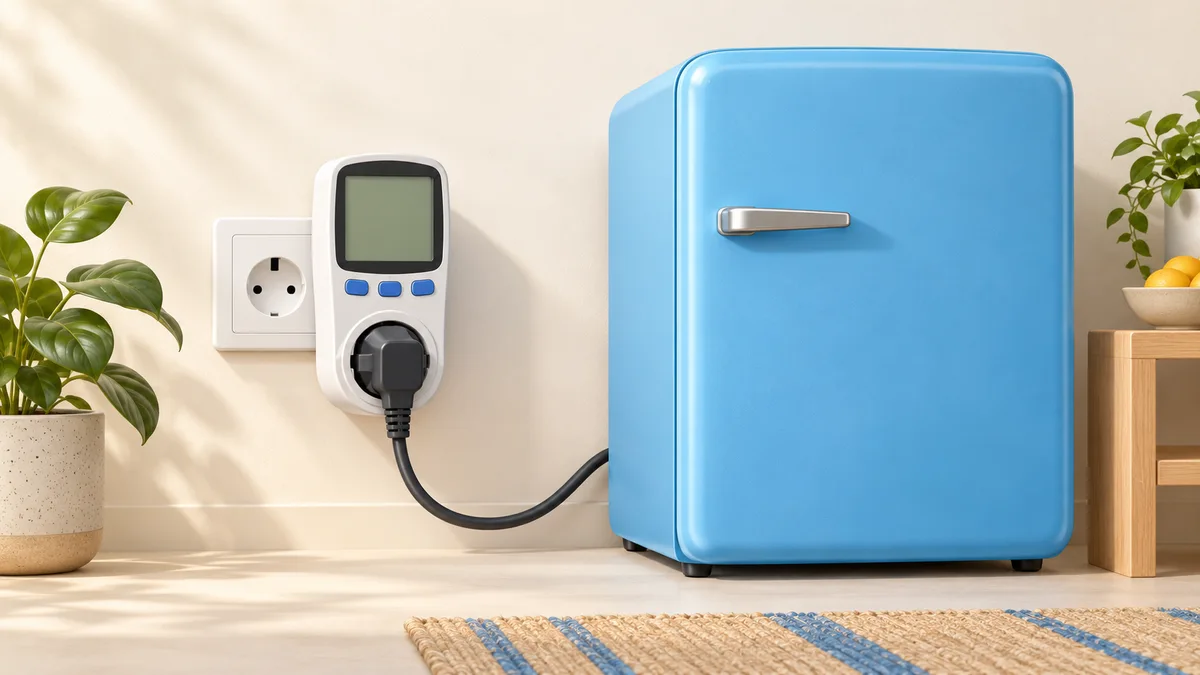
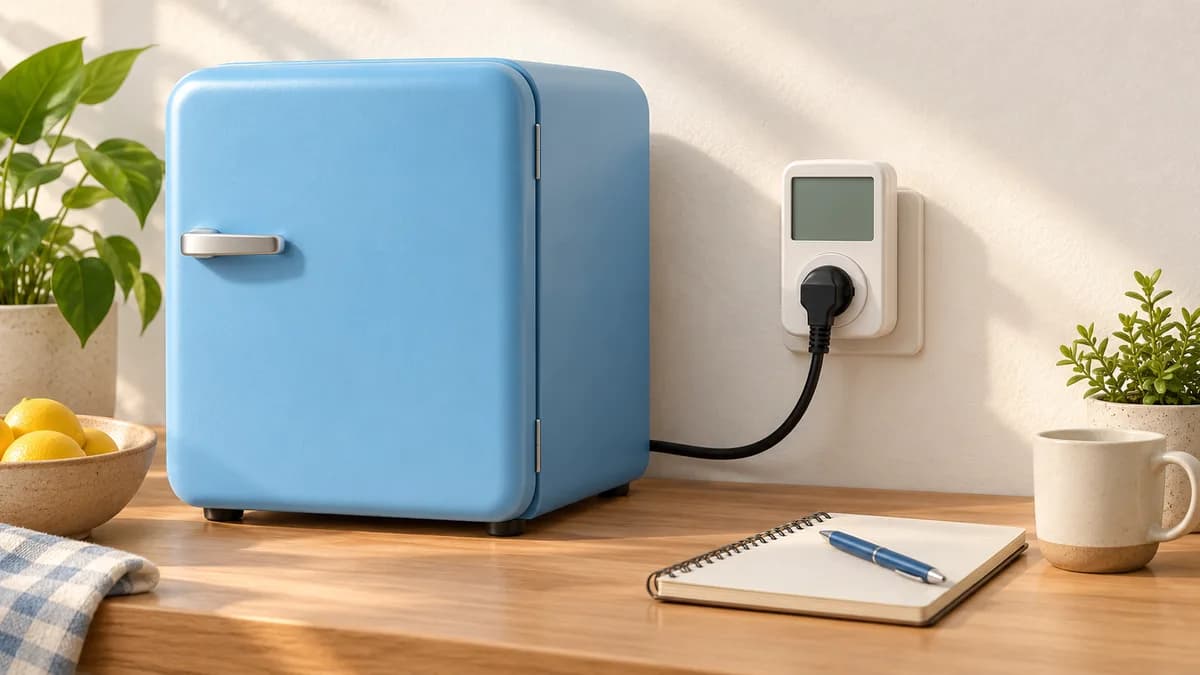
Use a plug-in energy meter suitable for the appliance's voltage, current and startup requirements, and follow both devices' instructions. Do not use an underspecified adapter or an extension arrangement prohibited by the fridge manual. An accumulated kWh reading over several ordinary days captures cycling better than one instantaneous power display.
Record the measurement period, room conditions and normal use. As an illustrative calculation, 4.2 kWh over seven days averages 0.6 kWh per day, which projects to 219 kWh over 365 days. That projection is not a full-year measurement: hotter seasons, different loading and more door openings can change it. Repeat in representative conditions if the estimate matters to your budget.
Sources: Virginia Tech Extension: estimating appliance energy use; Midea WHS-65L user manual: installation and energy tips
Improve the setup without compromising food storage
Follow the required ventilation clearances, keep the door closing properly and avoid placing the unit beside a heat source. Clean and defrost according to the manual. Frost, blocked airflow and frequent prolonged door openings can change the work the appliance must do, but we cannot assign a universal savings percentage to fixing them.
Do not raise the temperature above safe food-storage limits to chase a smaller bill or switch off a stocked refrigerator overnight. Choose a format that meets the real storage need, then compare its energy label. Our bedroom mini-fridge guide separates compressor refrigerators from ambient-dependent convenience coolers so an apparently low-power device does not become the wrong purchase.

Sources: Midea WHS-65L user manual: installation and energy tips; FDA: refrigerator thermometers and food safety; US Department of Energy: Energy Saver guide
Common questions
Does a mini fridge use electricity all day?
It stays connected, but a compressor commonly cycles rather than drawing full running power continuously. Measure accumulated kWh or use the model energy label.
Is a smaller fridge always cheaper to run?
No. Design, insulation, freezer configuration and actual use matter as well as size. Compare exact-model annual kWh.
Can I turn it off at night to save electricity?
Do not do this with perishable food inside. Storage temperature must remain safe, and the manufacturer may recommend continuous operation.
PUT IT INTO PRACTICE
Compare your options
Compare five compact refrigeration formats, their storage layouts and installation limits.
Best mini fridges for bedroomsSources and editorial approach
ChooseRight researched the sources below to explain the topic and its practical trade-offs. Examples are illustrations, not results from our own product testing. Sources checked October 23, 2026. Artwork is AI-generated for explanation and does not document hands-on testing.